At a time when MFA programs all over the country are struggling with enrollment numbers and changes to federal student loan programs that put pressure on current as well as prospective students, it’s a rare thing to get to celebrate the reopening of a program. Yet this is just what is happening at Pittsburgh’s Chatham University, whose low-residency MFA program, established in 2009 and deactivated in the fall of 2023, is once again open for applications.
Program director Sheila Squillante says she learned in the summer of 2023 that a large and unexpected budget shortfall across the university had put the low-res program in jeopardy of closure due to low enrollment. (Chatham also has a full-residency MFA, which was not threatened.) “By the fall, I was in regular meetings with the dean and provost about the future of the low-res, and it looked pretty bleak. The best we could argue for, instead of a full closure, was to be placed on an admissions hiatus for at least as long as we finished teaching out our remaining students. I remember asking the dean whether she thought after a few years of dormancy, the program might be able to come back. Her answer—not in your tenure or mine—seemed to sound the death knell. I hated having to tell the students.”
.png)
However, within a year, a full administrative turnover—president, provost, and dean—had taken place, and with it came a new opportunity to argue for the value and reinstatement of the program. At the same time, queries about whether Chatham offered a low-res or online program started coming in from all sides. “That felt frustrating,” Squillante recalls, “but it did give me some anecdotal evidence to support the argument that we ought to have one.”
The new dean encouraged her to spend some time thinking about how the program might be revised to retain its core strengths while including new experiences that would be attractive to students looking more and more toward distance learning. “The faculty had long discussions about what this could look like, and we agreed that we should build something around our already established reputation for having a kind of hybrid or shared curriculum between the full and low-res programs,” Squillante says.
The new low-res program includes one-on-one mentorships in creative writing taken with award-winning writer-educators just as the old program did, but now also includes asynchronous online courses shared with the full-residency program, like Travel Writing, The Environmental Imagination, and the practicum for The Fourth River, Chatham’s literary journal of nature and place-based writing. These courses will deepen the educational experience and also connect the low and full-res students for valuable peer-to-peer feedback.
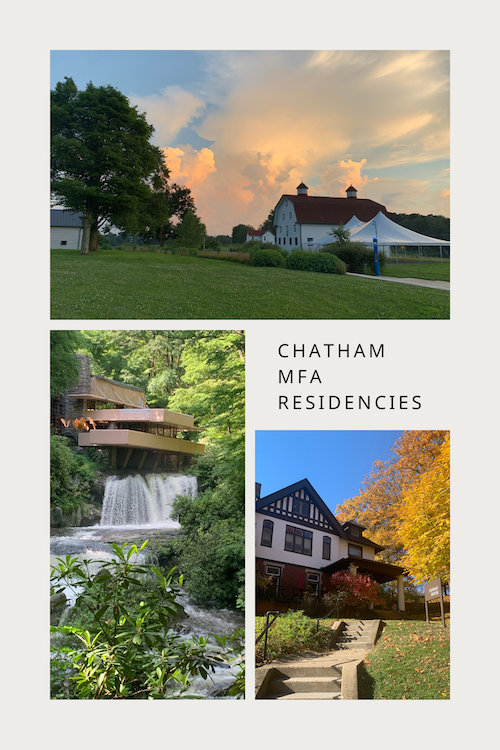
“Previously we offered one ten-day residency a year at our Eden Hall Farm campus,” says Squillante. “It was a great experience—rigorous, challenging, exhausting, fun—but I always felt like we might better serve students by offering more than one residency per year. That kind of in-person community is so vital to writers.”
Now, low-res students will join their full-res peers for a weeklong orientation residency on Chatham’s Shadyside campus in Pittsburgh at the start of the academic year and also attend a weeklong summer residency at beautiful Eden Hall Farm. Additionally, students will have the option to attend a five-day residency at Fallingwater, Frank Lloyd Wright’s iconic dwelling in Mill Run, Pennsylvania, an hour outside of Pittsburgh. The Fallingwater Residency in Nature and Place-Based Writing is an exclusive feature of the Chatham MFA programs and builds on the legacy of Chatham’s most famous alumna, environmentalist Rachel Carson, a creative writer with a social conscience.
Finally, like many of Chatham’s graduate programs, the MFA (both full and low-res) has undergone a tuition structure review in order to account for the end of federal Grad PLUS loans and new borrowing limits for students. “Our low-res tuition has been reduced from $1,160 to $675 per credit, bringing our thirty-six-credit hour program down to under $25,000 total. That’s a meaningful savings that I hope will make it easier for students to choose a Chatham MFA degree,” Squillante says.
She also emphasized the supportive, inclusive community students will find at Chatham: “Our MFA program is part of a graduate school that has the heart of a small liberal arts college. This means your professors and mentors will really get to know you as a person and a writer. We meet you where you are and work with you to set and reach your writing goals. At Chatham we invite you to inhabit and express your whole self. We welcome writers of all backgrounds, interests, and identities into a community of mutual care, curiosity, and respect.”
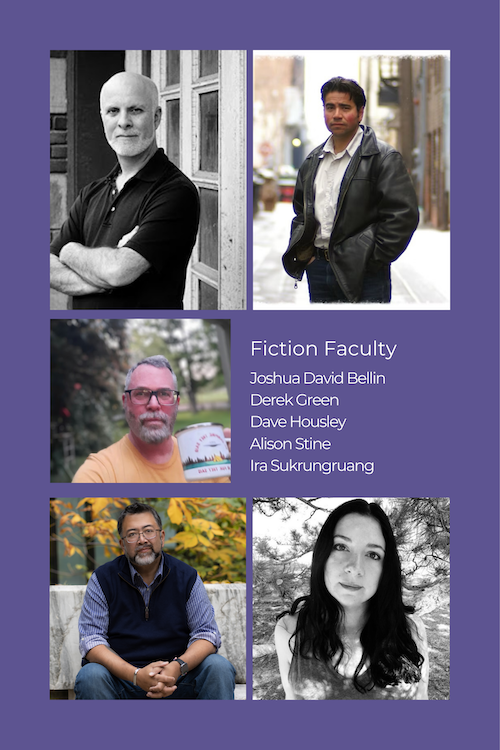
Some of those mentors include writers like celebrated Pittsburgh poet Cameron Barnett, essayists Sakena Washington and Ira Sukrungruang, and fiction writers Joshua David Bellin and Dave Housley, among many others. Squillante herself will be part of the low-res faculty, available to work with poets and essayists alike.
“I really love that the new program is being built with the strengths we’ve always had while also offering some exciting new things,” Squillante says. “Higher ed is changing daily, and I’m deeply grateful to teach in a place like Chatham, which has shown itself to be creative, adaptable, and responsive to those changes.”
Applications to join the fall 2026 cohort are open with a rolling deadline. Learn more by visiting the program’s website or by contacting Sheila Squillante at [email protected]
At the end of the program, I left with the discipline not just to write but to edit my work well and the tools to pursue publication. I could say something extraordinary about the value of each instructor's contribution to developing my skills. I wouldn’t be the writer I am today without each of them.
—Maria Reynolds Weir, Low-Res MFA, 2015
I was nervous to be back at school at a mature age. It was a gift to be welcomed, encouraged, and sustained in a profound environment which did not care one whit that the last time I had been in the education system, we used typewriters. My writer’s rust was gently brushed off by instructors who cared deeply about the work and about my progress.
—Julia Silverman, Low-Res MFA, 2020
As a retired student, I found Chatham’s MFA program to be an ideal environment for pursuing my passion for writing. The nurturing yet challenging atmosphere helped me find my voice and refine my craft. Practical experiences and a commitment to revision transformed my writing. I highly recommend this program to writers of any age.
—David Brady, Low-Res MFA, 2025