Soon after springtime arrives in Grand Forks and the first prairie flowers break through the cold crust of the earth, flocks of Canada geese return to the coulee on the University of North Dakota campus. The air crackles with their reedy calls. And suddenly, it seems, campus brims anew with life.
Ever since I arrived at UND in 2017, this campus pastoral has felt, to me, like a precious cameo of our creative writing program’s tight-knit community. It’s energetic, vibrant, a wonderful place to craft stories and make art. While the COVID-19 pandemic tested many communities, those years were anything but a fallow period for us. In spring 2020, our students revived the campus literary magazine, Floodwall, as a student-run literary magazine for writers and artists enrolled in any UND program. Soon, Floodwall became a keystone of our program, providing writers from across our campus community with a supportive venue for their work, while also furnishing students in our publishing and editing program with experiential learning inside and outside of the classroom.
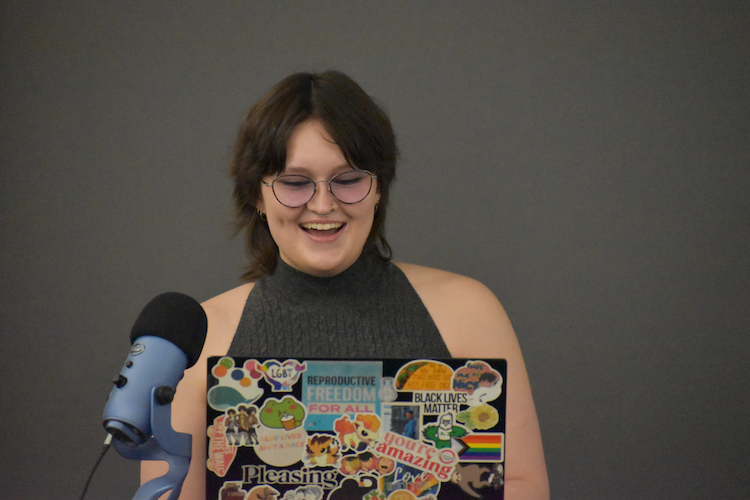
Floodwall managing editor Caitlin Scheresky introduces a new issue of the magazine at the fall 2024 reading and launch event.
Photo credit: Chloe Piekkola
In those five swift years since Floodwall relaunched, our program has blossomed and flourished. We’ve added a new undergraduate certificate program in creative writing, welcoming students from fields outside of English and literary studies to creative writing. We’ve extended the learning opportunities in our certificate program in writing, editing, and publishing—after working on Floodwall, students work as editorial assistants for North Dakota Quarterly, one of the longest-running little magazines in North America. Alongside that, the UND English Department now supports our creative writing and publishing program with a digital production suite, including an array of brand-new Macs equipped with Adobe software and other digital creation tools.
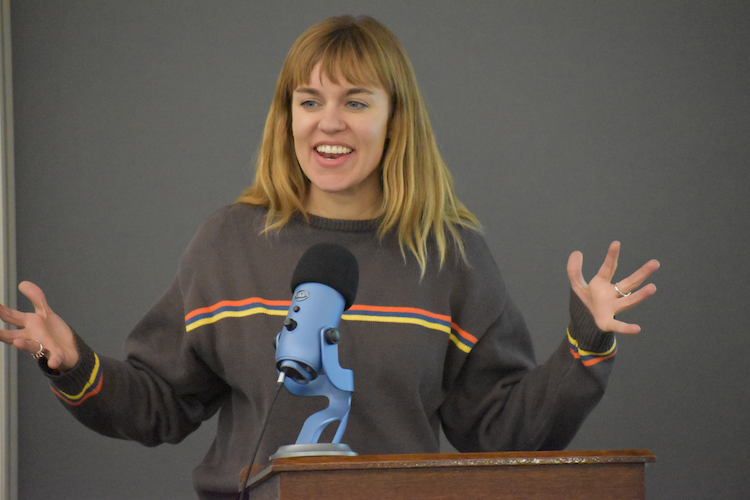
Courtney Kersten (UND writing faculty, creative nonfiction) introduces Floodwall student editors at the fall 2024 reading and launch event.
Photo credit: Chloe Piekkola
These new strides have benefitted our graduate program, as well. Our fully funded MA program allows students to revise creative work for their portfolio projects—an increasingly popular option. At the graduate level, starting in the 2025–2026 academic year, the UND English Department is officially reopening the creative dissertation option in our doctoral program. (Like the MA program, the PhD program is also fully funded!)
Creativity flocks (if you’ll pardon a delayed goose pun) to UND year-round. My colleague, the nonfiction writer Courtney Kersten, and I work year-round to celebrate that at UND, by fostering a literary community where everyone feels welcome to the roost. Whether that’s through our open mic nights, each semester’s Floodwall launch celebration, or our graduate reading series, we showcase the writers, editors, and creators working in our campus community, every chance we get. And it doesn’t stop there, as our program connects current students with alums and professionals in the field. Our program also includes alumni readings (like an April 2025 reading by UND alum Bill Thorness, author of All Roads Lead to Rome), as well as a virtual speaker series featuring conversations with editors, publishing professionals, and writers representing a range of genres.
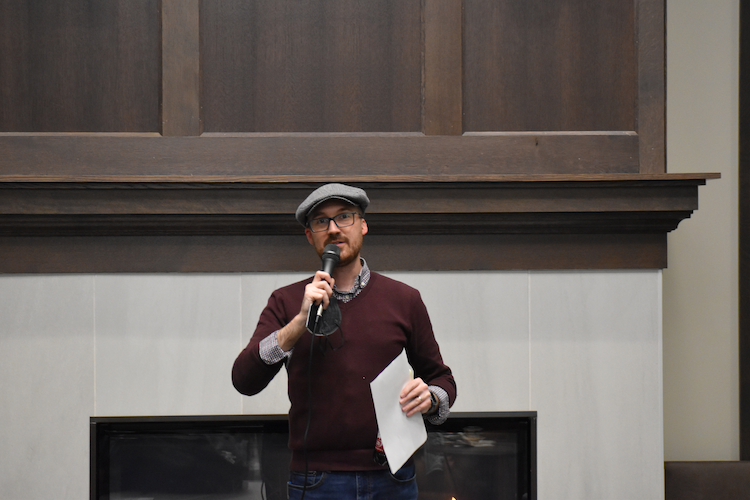
Patrick Thomas Henry (UND writing faculty, fiction; program coordinator) welcomes student-writers and community members to an open mic night.
Photo credit: Chloe Piekkola
Decades of literary traditions in the UND English Department have made this possible. Chief among those is the annual UND Writers Conference. Founded in 1970 and held each year since, the Writers Conference is a free and open-to-all literary festival. We held the fifty-sixth annual conference in March 2025, and it featured three dazzling days of panels, readings, workshops, community open mics, and more. This year’s conference, “Makers & Machines,” brought Lisa Ko, Kristen Radtke, Lillian-Yvonne Bertram, Kenzie Allen, Eugene Lim, and visual artist KT Duffy to Grand Forks.
The UND Writers Conference is a vibrant, vital reminder that literature is alive—and that creative writing is for everybody. UND students, community members, and folks from around the region got to not only hear from these writers, but also learn directly from them through informal workshops and creative activities. Across its fifty-six-year history, the Writers Conference has brought some of the biggest names in American letters to the northern plains. Despite UND’s remote location, the Writers Conference has welcomed visits from Salman Rushdie, Alice Walker, Roxane Gay, Truman Capote, Tommy Orange, Karen Russell, Yusef Komunyakaa, Art Spiegelman, Tracy K. Smith, and numerous others. To make sure that this wisdom remains the common good of all, we maintain a digital collection of past Writers Conference readings, panels, and events. Maintained by Crystal Alberts and UND’s Chester Fritz Library, the Writers Conference digital collection ensures that these treasures remain free and accessible to writers, students, scholars, and all.
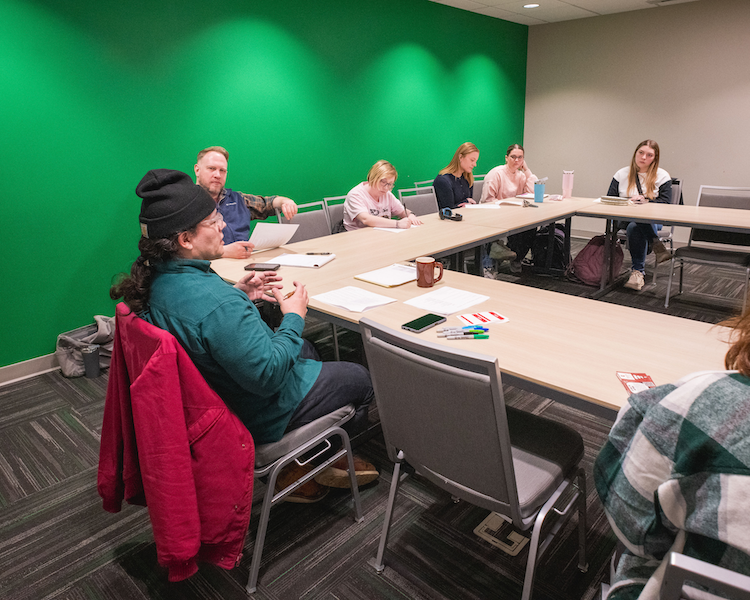
Casey Fuller (UND English PhD student) leads a community workshop at the UND Writers Conference in March 2025.
Photo credit: Grant McMillan
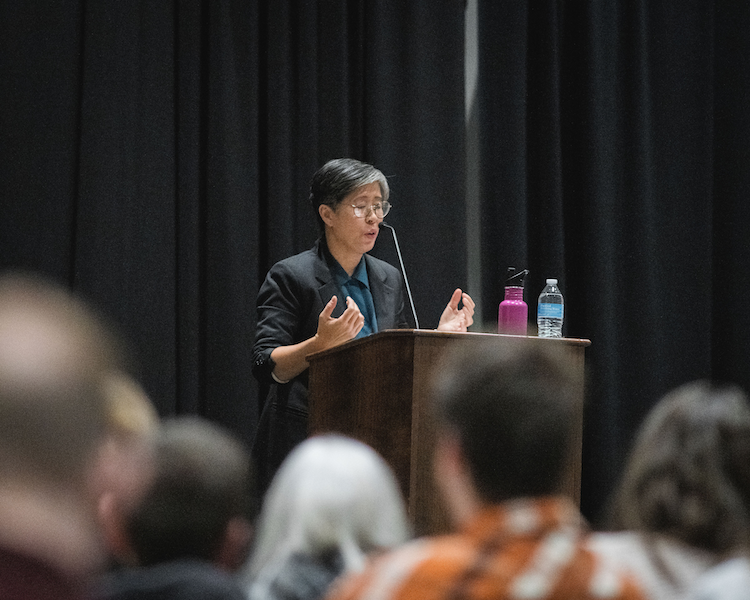
Visiting author Lisa Ko reads at the 56th Annual UND Writers Conference in March 2025.
Photo credit: Grant McMillan
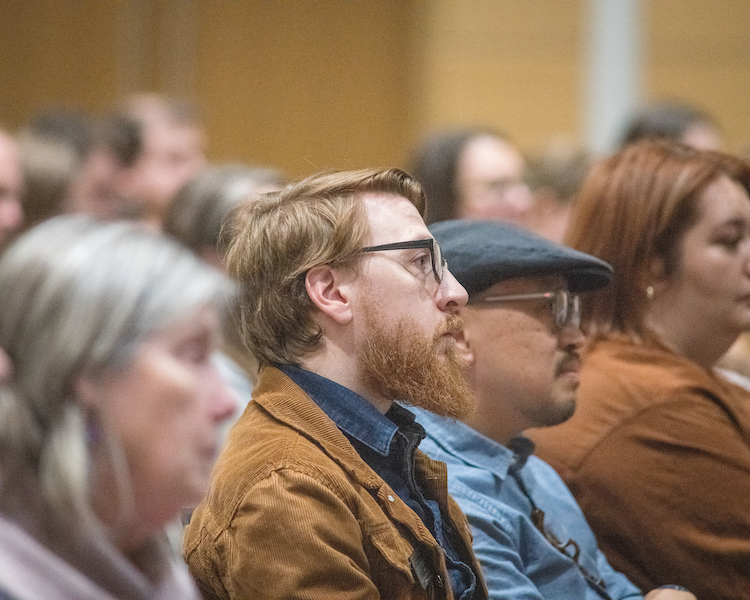
A rapt audience listens in at the 56th Annual UND Writers Conference in March 2025.
Photo credit: Grant McMillan
Our program cherishes the opportunities to connect with writers on campus and in the community. As UND’s creative writing faculty, Courtney and I share a conviction that writers should make creativity, literature, and the arts more accessible to all. We regularly partner with the Grand Forks Public Library (and other organizations in the greater Grand Forks region) to host community workshops and discussion events. Often, grad students and upperclassmen participate, too—both as workshop leaders and writers!
The prairie—especially far in the north—has a reputation for high winds and harsh winters. Thomas McGrath’s “Beyond the Red River” described the brisk North Dakota autumn as a “wait for a winter lion, / body of ice-crystals and sombrero of dead leaves.” But no matter how cold or long the winter, it’s always a creative springtime in the literary community at UND. And that’s something I recall tenderly each year, when the geese return to the campus coulee and the newest issue of Floodwall is ready to launch.
Patrick Thomas Henry is the coordinator of the creative writing program at the University of North Dakota and director of the annual UND Writers Conference. His debut short story collection, Practice for Becoming a Ghost (Susquehanna University Press, 2024) was longlisted for the Story Prize. He is also the fiction and poetry editor for Modern Language Studies.